
In today's competitive job market, workplace location has become among the most critical factors in attracting and retaining top talent. A well situated workplace can help foster creativity, enhance collaboration, and positively contribute to employee morale + well-being. Meanwhile, a poorly located workplace (characterized by isolation and absent of human scale design, engagement, or support) can have exactly the opposite effect leading to institutional brain-drain, steady team churn, and employee dissatisfaction.
This may seem obvious but we haven't always thought about the office in this way. Technology has revolutionized the way we work, allowing people to work from virtually anywhere, a significant shift from the traditional workplace strategy that centered around large, consolidated corporate campuses. Along the way advances in cloud computing, high-speed internet, and collaboration tools like video conferencing, and digital project/product management platforms have enabled employees to stay connected + productive without the need for a centralized physical office. Rigid, location-based operations have given way to a more dynamic, distributed approach, allowing talent to be sourced on a global scale. Adjacency to public transportation, vibrant street life, and abundant dining, lifestyle + entertainment options have usurped large, blank floor-plates and proximity for the sake of proximity. Companies of all sizes are embracing a more distributed work model by prioritizing employee choice and locating offices in the heart of cities where they stand the best chance of attracting and retaining top talent - among those; Lowes, NCR, & Chick-Fil-A.
Lowes (Charlotte, NC)
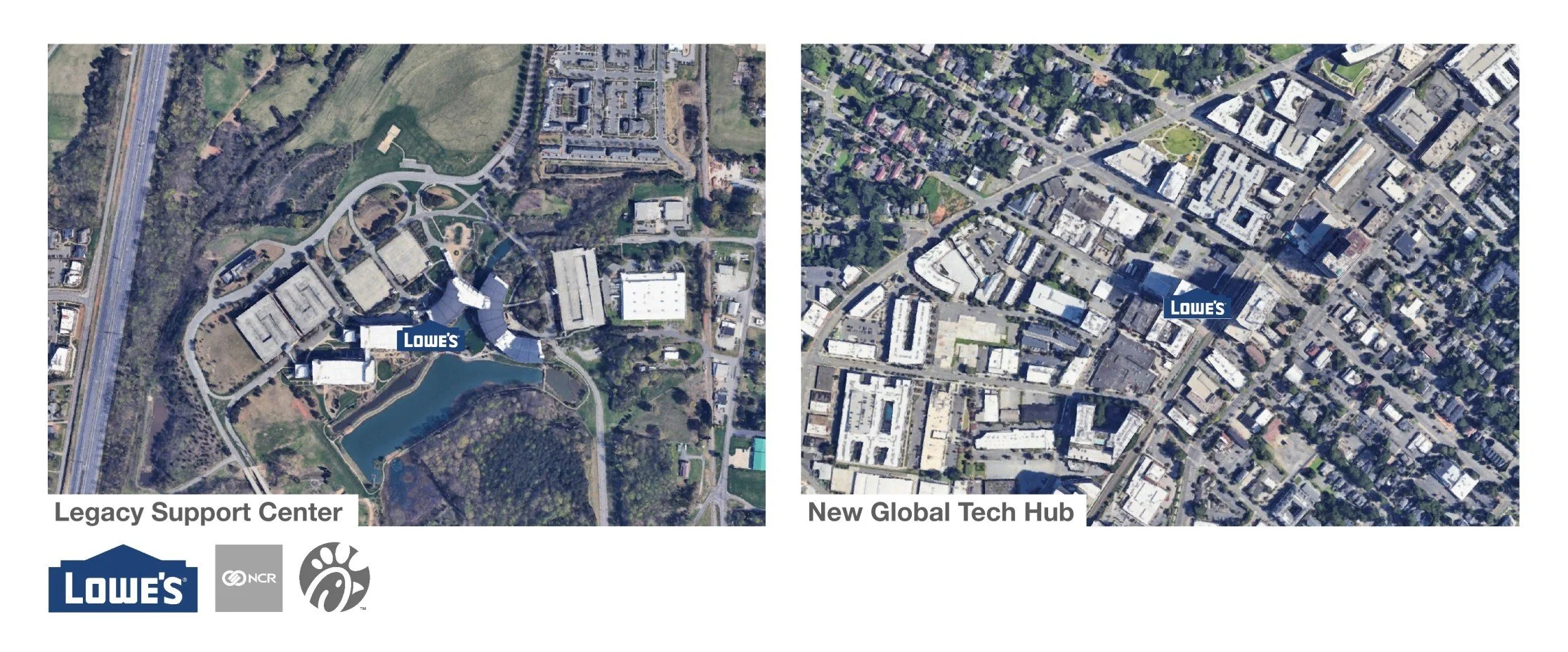
(Left) The rural Legacy Lowe's Store Support Center [Mooresville, NC] vs. (Right) The New Lowe's Global Technology Hub [Charlotte, NC] | Images from Google Earth
Lowe's, the nation's second largest home improvement retailer, purchased the sprawling Wilkes Mall in 1998 (Wilkesboro, North Carolina) to house its original headquarters and store support center. In 2003, Lowes relocated from the mall to a 350-acre campus in rural Mooresville, North Carolina. Approximately twenty-five miles outside the city center of Charlotte, NC, the Mooresville Campus has grown to house 2,400+ employees distributed across several low-rise buildings surrounding a pastoral 7-acre lake. In 2013 when looking to further expand, the company opted not to grow the current campus but instead decided to invest over $150 million in a new 23-story Global Technology Hub situated in the bustling SouthEnd neighborhood of Charlotte. The building, designed by Childress Klein, is planned to host up to 2,000 employees including some from the original Mooresville campus. Locating this office closer to where much of the Lowe's workforce actually lives allowed the company to tap into a deeper bench of talent and awarded existing teammates the flexibility to shift their daily operations to this modern, urban workplace environment.
"Flexibility really sells. Nobody wants to drive to an office to do a #Zoom call, and they don't have to. Commuting is way overrated."
-Tom Wilson, Allstate CEO
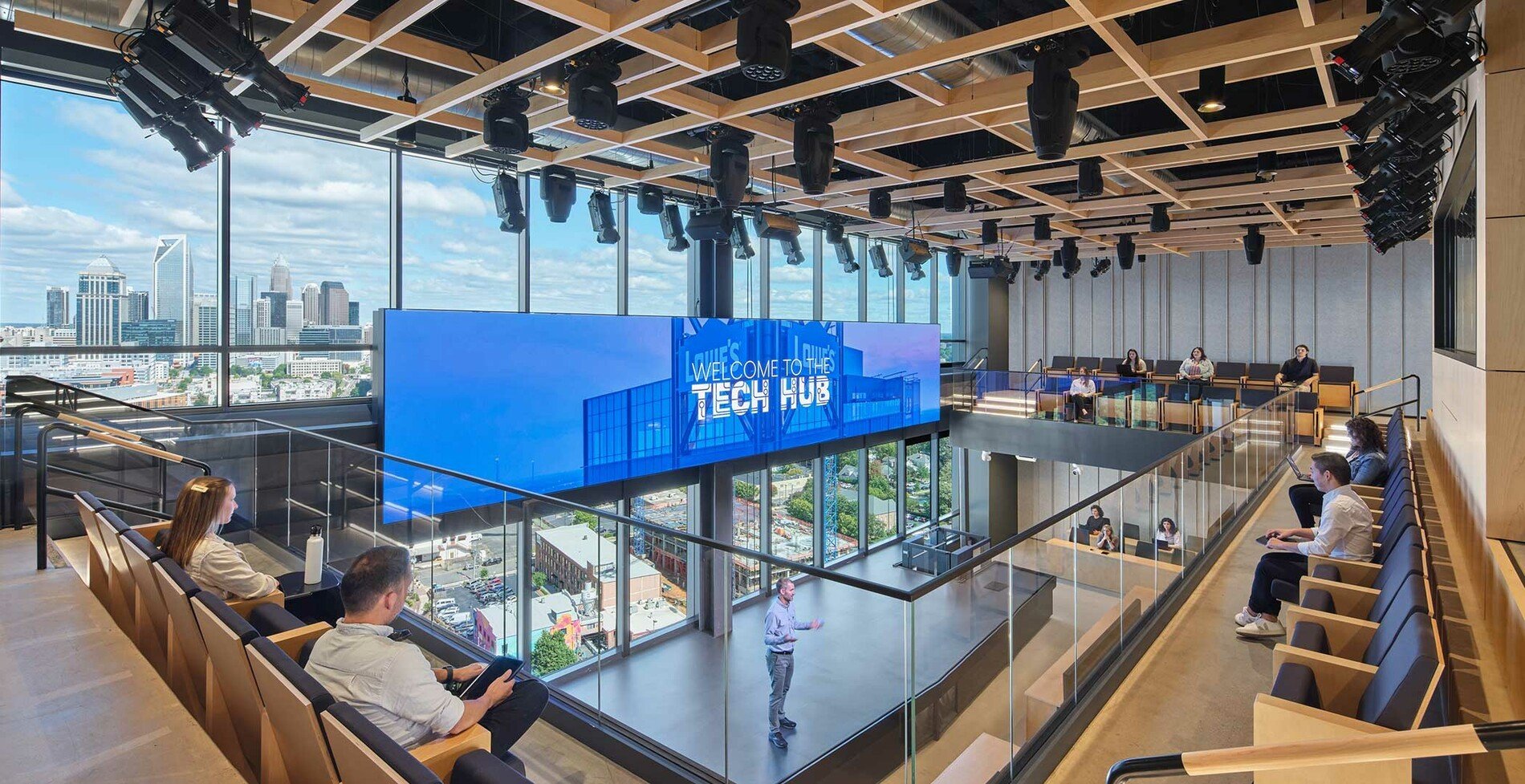
An all-hands space within the new, urban Lowe's Global Technology Hub (Charlotte, NC) | Design and photo by Childress Pane
NCR (Atlanta, GA)
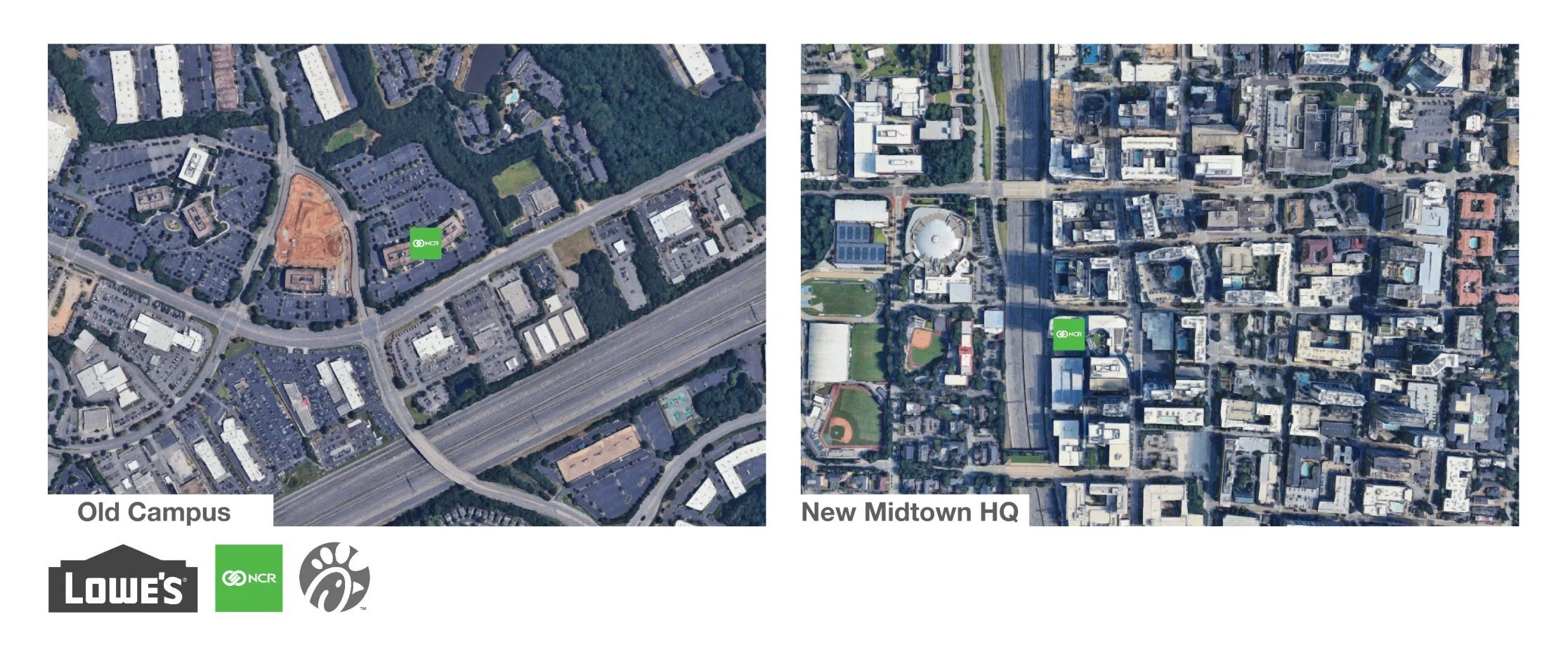
(Left) Original Suburban NCR Atlanta Headquarters [Alpharetta, GA] vs. (Right) The New Midtown NCR World Headquarters [Atlanta, GA] | Images from Google Earth
The National Cash Register Company (NCR) was also looking for a fresh start when it relocated it's original Atlanta corporate headquarters campus from suburban Alpharetta, GA to the heart of Midtown Atlanta. Twenty-five miles away but adjacent to several of the region's preeminent universities (including The Georgia Institute of Technology - GA Tech, Georgia State University, and Emory University, among others), the Midtown Atlanta location was a departure from the car dealerships and sea of asphalt that surrounded the original Atlanta campus. Designed by Duda Pane with Interior fit-out by Gensler, the new 762,000 square foot, two-tower campus boasts multiple dining options, a coffee bar, employee gym, generous outdoor terrace space, and the company's NCR Innovation Lab (a partnership of NCR & The Georgia Institute of Technology - GA Tech). Dotted with open collaboration spaces, quieter touch-down environments, and a completely free-address (hot-desking) workstation seating model, innovation and employee choice are at the heart of the design. Rather than losing top talent to other tech-minded companies situated in Midtown Atlanta's bustling Technology Square (Travelers Insurance, Thyssenkrupp, Dematic, Cisco, among others), NCR is now an active part of that urban, high-tech innovation district.
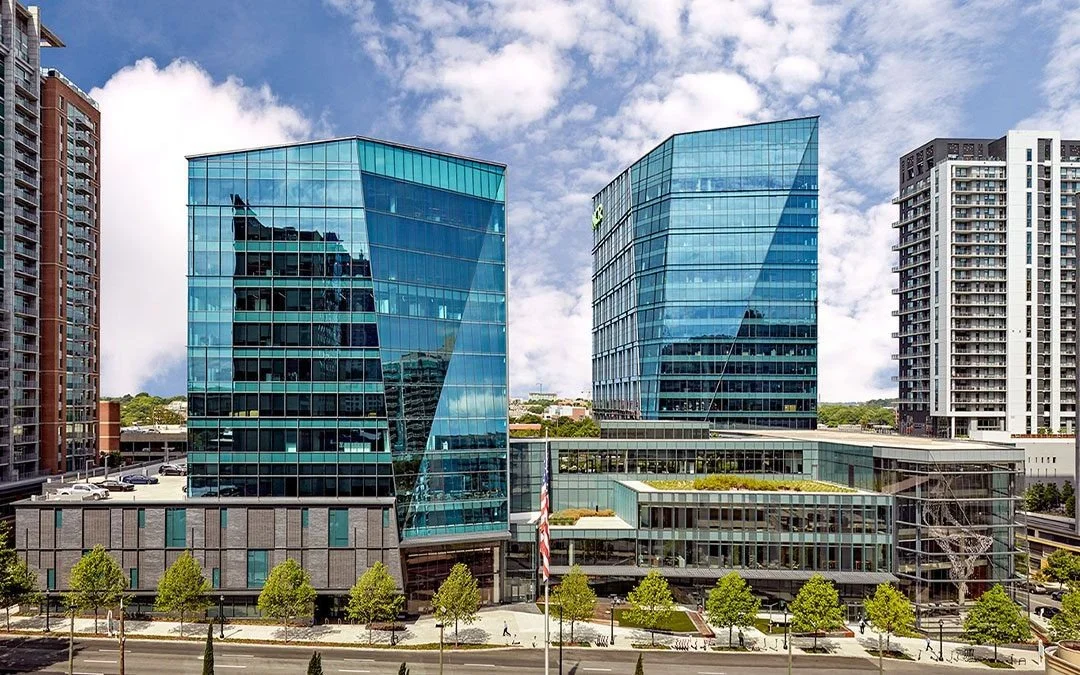
The new NCR Campus situated in the heart of Midtown Atlanta's vibrant Technology Square (Atlanta, GA) | Design and photo by Duda Pane
Chick-fil-A (Atlanta, GA)
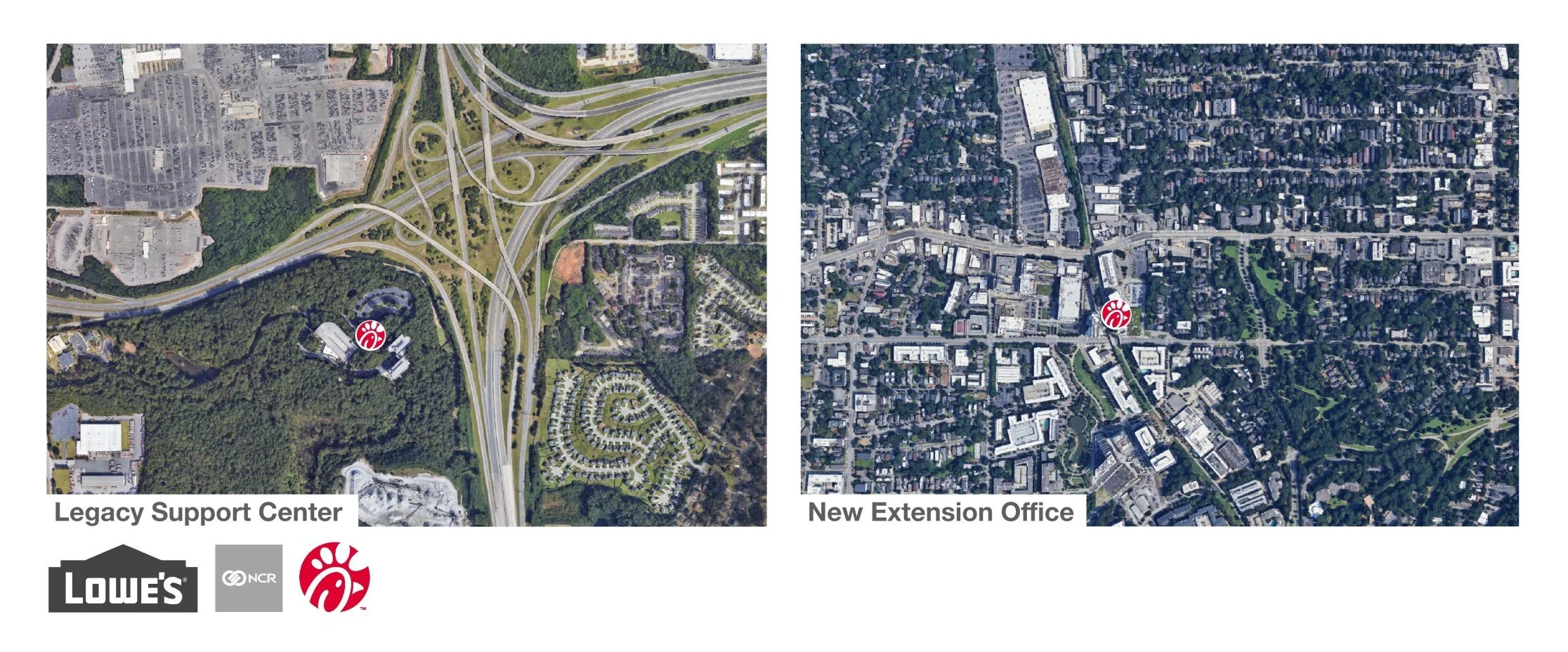
(Left) Legacy Chick-Fil-A Support Center [Atlanta, GA] vs. (Right) The New Beltline-adjacent Chick-Fil-A Extension Office at 725 Ponce [Atlanta, GA] | Images from Google Earth
When looking for a location for the new Chick-Fil-A Extension Office, the team landed on the vibrant 725 Ponce development in urban Old Fourth Ward (O4W) Atlanta, GA. A departure from the company's more suburban Legacy Support Center, situated south of Atlanta near Hartsfield-Jackson International Airport (ATL), the new Extension Office is surrounded by shops, entertainment venues, and restaurants and always abuzz with activity along the active Atlanta Beltline corridor. Designed by Smallwood, the 34,000 square foot Extension Office space includes flexible workstations, shared collaborative team spaces, and adaptable conference spaces of all shapes and sizes. A wide variety of collaborative and heads-down spaces are intended to maximize employee choice and untether team members from their workstations. Attracting new talent from the region's great universities and holding onto the team's talented employees became an easier sell once the satellite Extension Office opened and the company branched out beyond its isolated suburban office park roots. Chick-Fil-A even cited "allowing employees more flexibility" and "[creating more] workplace options" as reasons for establishing the Extension Office.
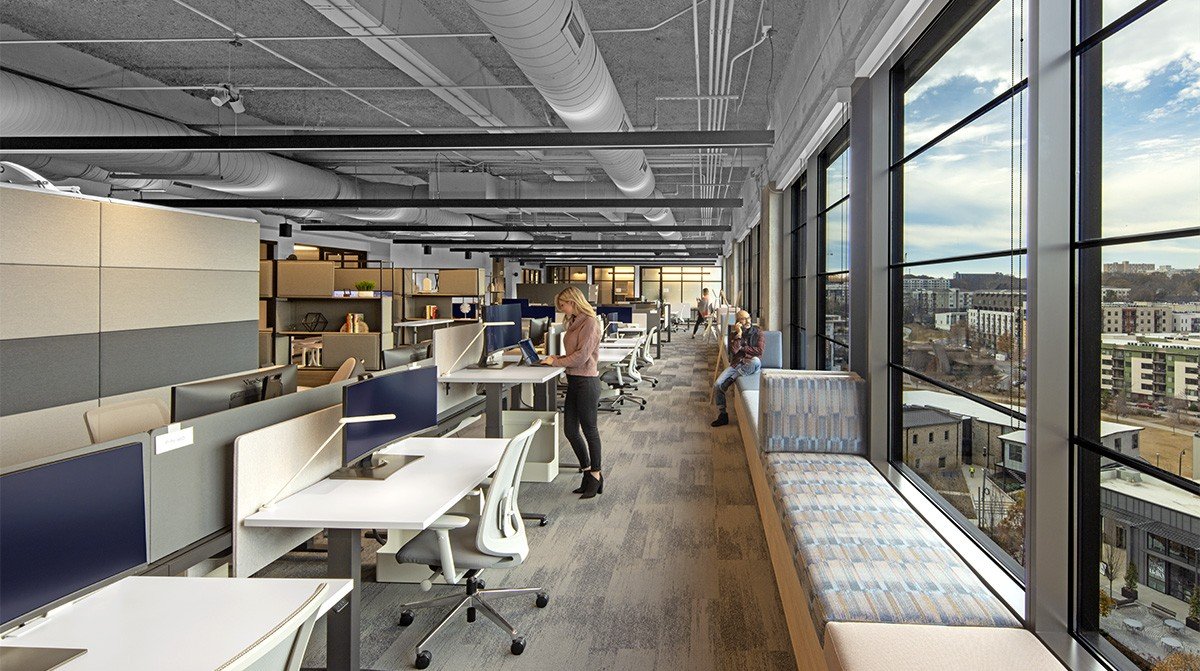
Interior of the 725 Ponce Chick-Fil-A Extension Office in the vibrant urban Old Fourth Ward Neighborhood (Atlanta, GA) | Design and photo by Smallwood
The physical workplace remains an essential tool for talent attraction and retention, even in an increasingly technological, hybrid, and remote work world. No longer are workers willing to accept the sterile campus, copy-paste, one-size-fits-all workplace solutions that were prescribed in the past. The workforce is demanding thoughtfully designed, strategically located offices which provide more than just a place to land—they help actively foster collaboration, enhance team morale + well-being, and can strengthen overall company culture. Sometimes this is across a more centralized yet distributed workplace model (as with the examples above), but other time's it's with through partnering with co-working and other flex providers to empower more employee choice + fill those non-centralized office days. Employees are drawn to workplaces that break from the mold to offer flexibility, comfort, outside amenities, and a true sense of belonging.
By investing in spaces that reflect the evolving expectations of the modern workforce, companies can cultivate an environment where top talent not only thrives but is also motivated to stay for the long term. After all, the right work.place isn't just where people work—it's where they want to stay, succeed, and grow.
