
If you drive down I-85 in Atlanta right now, two new(ish) glass towers rise above the (pollen-laden) tree canopy:
Children’s Healthcare of Atlanta’s Arthur M. Blank Hospital, a 19-story, 2M SF, 446-bed pediatric hospital that just opened in 2024.
Piedmont Atlanta’s Marcus Tower, a 16-story, 900k SF, 408 bed addition to the flagship hospital of Piedmont Healthcare, Georgia's largest healthcare system.
Both are designed with something most space planners and building operators would kill for: multiple shell floors intentionally left empty on day one to accommodate future growth. At Arthur M. Blank, the top four floors are shelled for future growth. At Marcus Tower, Phase 1 built out the lower 10 floors, with six additional floors planned to be fitted out one or two at a time through 2026.
In other words, these health systems just built the equivalent of a 35-story tower with only 25 floors in use today—and did it on purpose. The obvious question for space planners and work.place designers:
If hospitals can afford to carry empty floors for years, what do they know that the rest of us don’t? And is there a smarter way to use that space in the meantime?
Why hospitals build “too much”
Hospitals don’t overbuild by accident. Shelled floors are a deliberate, increasingly common strategy, particularly for the once-in-a-generation size scopes these two projects represent:
Arthur M. Blank Hospital chose to “maximize height with the initial build” because vertical expansion later would be “very operationally disruptive,” so they topped out the tower and left the top four floors as shelled space for future expansion.
Marcus Tower was designed as a high-rise that could be delivered in phases: Phase 1 opened with 84 critical care beds and 48 acute beds on the lower 10 floors during COVID, with six shelled floors above to be built out over time.
Similar patterns show up elsewhere at WakeMed Cary, which added a vertical expansion with shell space for future renovations and growth, Emory Johns Creek, which added two floors and left one shelled, and Monroe Carell Jr. Children’s at Vanderbilt, where two shelled floors were later built out a decade after the original project.
Hospitals can justify building for the future because their constraints (and capital) are fundamentally different. When you’re planning 20–40 years out, can reasonably predict demand, and face massive operational risk from expanding later, overbuilding becomes risk mitigation, not speculation. Pair that with philanthropic funding and tax-advantaged financing, and shelled space isn’t a vacancy problem—it’s a strategic reserve.
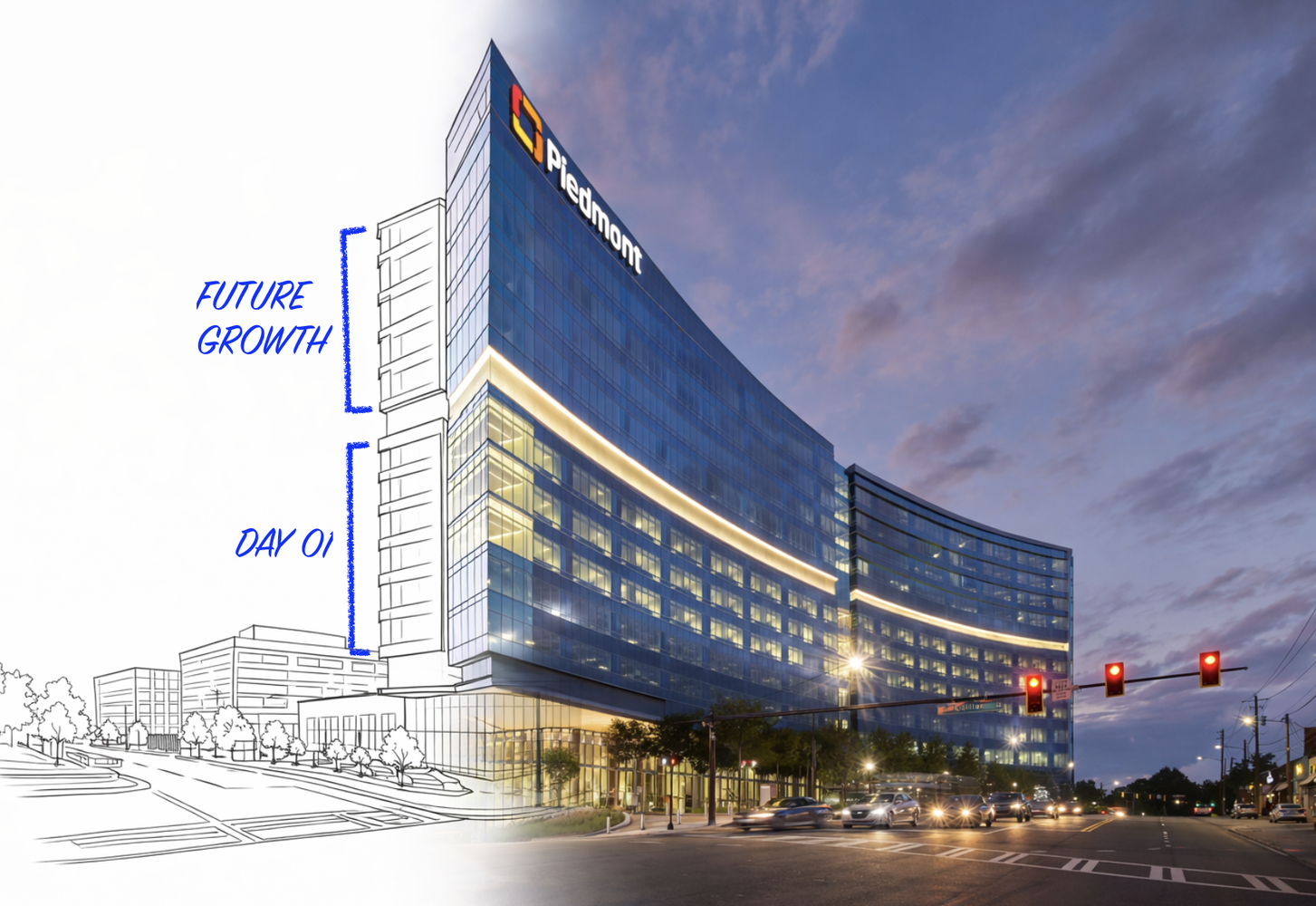
Marcus Tower (Piedmont) showing space for future growth | Visual Concept by Brendan Gregory
Is there a work.place parallel?
So if building empty floors into your next project isn't an option... what are options for work.place planners and designers looking to reap the same long-term benefits?
Look to potential interim uses for your excess space:
Sublease / Bank of America was in the news recently for a high profile New York City lease. During a time of continued absorption in the market, the Charlotte based bank and financial services corporation inked a 20 year lease for the full office (2.4 million square feet) portion of its namesake tower at One Bryant Park. The company reportedly plans to grow into the space over time but sublease to the current building tenants in the meantime.
Monetize / Operate (or partner with someone like Industrious) and activate excess space. This adds energy to the space, creates an instant amenity for the rest of the building, and could even fuel a long-term leasing pipeline. CBRE leaned into this model when building out their Global Financial Headquarters at Lever House in Midtown Manhattan. A combination of traditional office and flexible space, this arrangement will allow CBRE to grow its occupancy over time, share in amenities and programming with the adjacent Industrious workspace and benefit from profits generated by the Industrious workspace.
Pop-ups / Brand Activations / Zoom encouraged New Yorkers to "take back lunch" by hosting a speakeasy style popup burger shop called The Hard Stop Burger Shop. That underutilized floor or corner of your building might just be someone else's treasure serving as the perfect location for a temporary pop-up or brand activation
This isn’t overbuilding; it’s pre-building. Hospitals can afford to carry empty space today to avoid costly disruption tomorrow. Offices usually can’t but they can treat excess space as an opportunity to flex, monetize, and evolve, not just a liability to backfill. The lesson for work.place? If you plan to be around long enough to grow, start building like it.
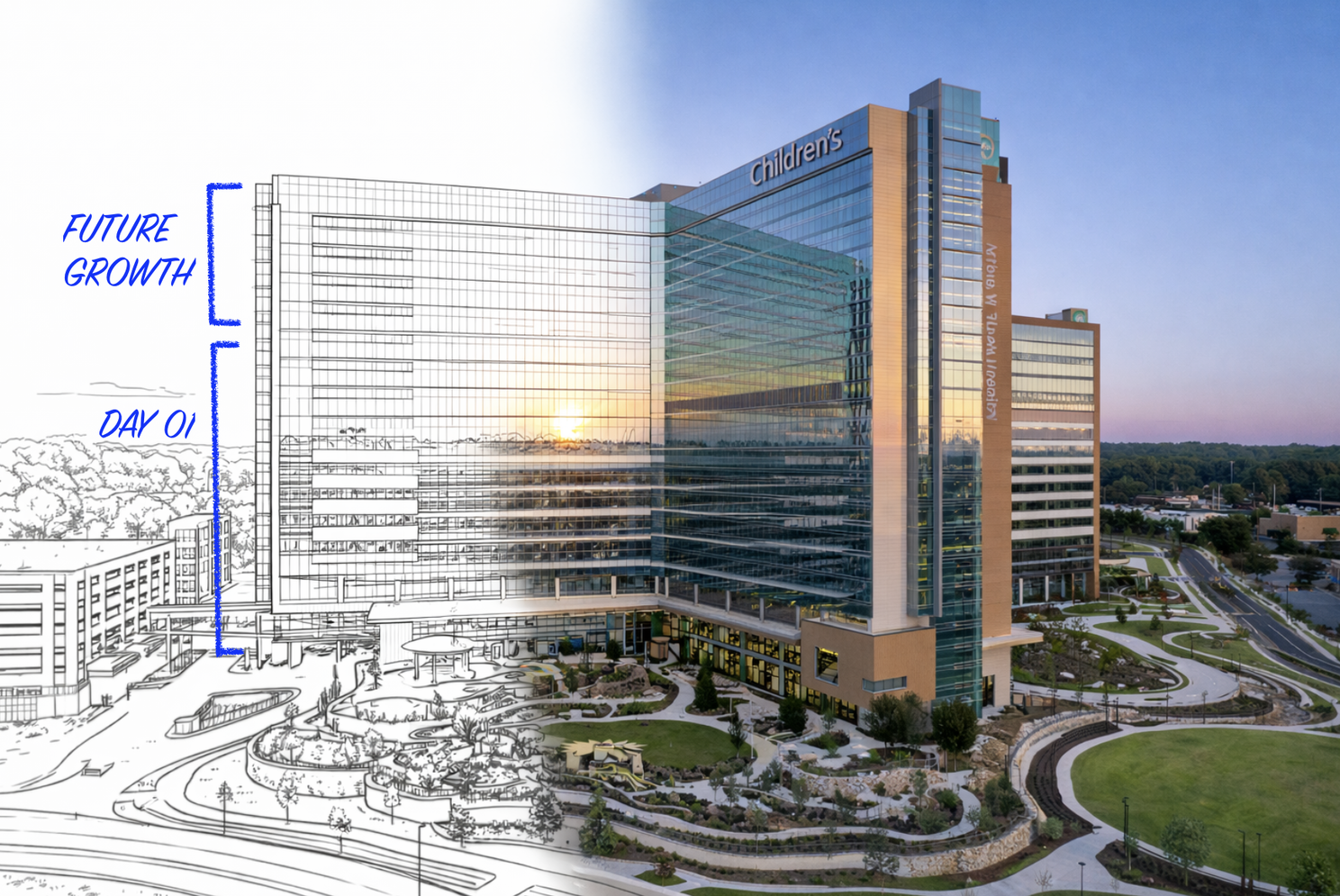
Arthur M. Blank Hospital (Children's) showing space for future growth | Visual Concept by Brendan Gregory
