
From Space to Place: Lessons from Urban Design
In urban planning and design, there's a common concept known as placemaking.
At its core, placemaking is the process of transforming a space into a place. While definitions vary, the common thread is that great places don't emerge solely from architecture or infrastructure, they emerge from understanding the people who use them and shaping environments around their needs, behaviors, and aspirations.
The idea isn't a new one. Jane Jacobs argued for lively sidewalks and neighborhoods built around everyday human activity. William H. Whyte famously spent years filming how people actually used plazas in New York City, discovering that seemingly small details—movable chairs, food vendors, sunlight, and places to sit—had an outsized influence on whether people lingered. Organizations like Project for Public Spaces have since helped bring placemaking into the mainstream, inspiring cities around the world to think less about what they were building and more about how people would experience it.
Today, the philosophy influences everything from downtown revitalization efforts and neighborhood Main Streets to waterfronts, parks, public squares, and university campuses. While the approaches vary dramatically, they all share a common thread: they intentionally shape the relationship between people and place.
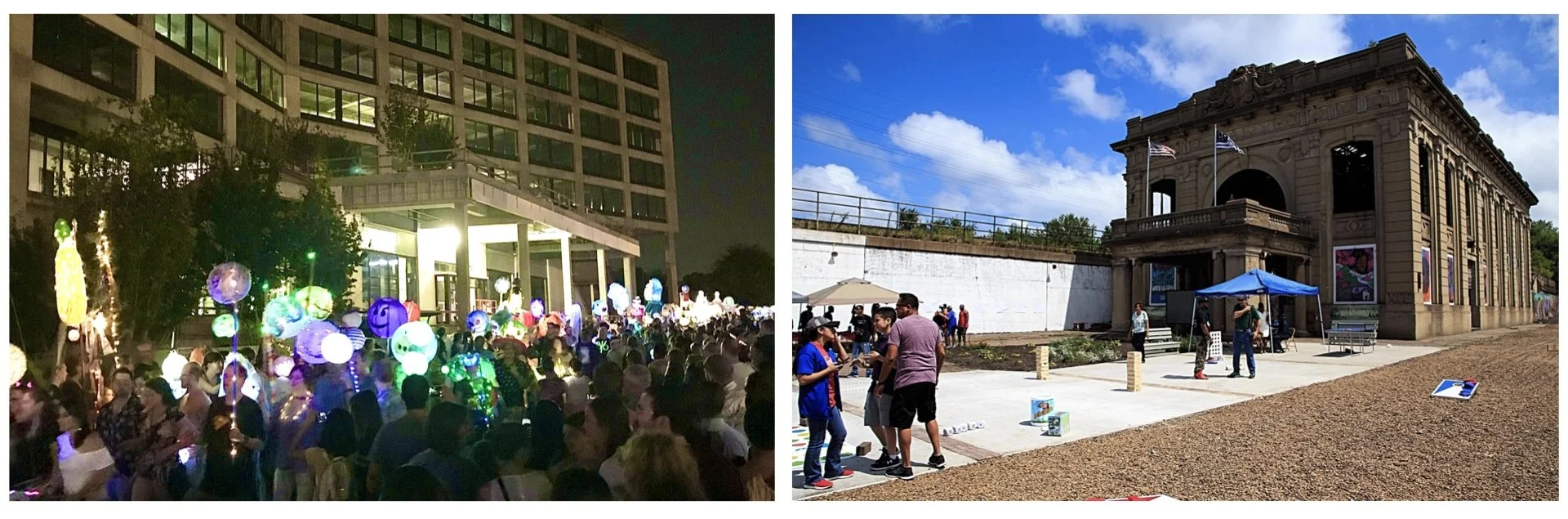
(L) Atlanta Beltline Lantern Festival (Atlanta, GA) Image by Brendan Gregory | (R) Union Station Revival (Gary, IN) Image via Decay Devils
Placemaking in Practice
Atlanta Beltline Lantern Parade
Sometimes placemaking is about establishing a ritual. Once a year, thousands of people converge on the Atlanta BeltLine for the Lantern Parade. The BeltLine—an urban design and placemaking success in its own right—transformed an abandoned freight rail corridor into one of Atlanta's defining public spaces. Then, for one evening each year, it transforms again: a glowing procession of handcrafted lanterns stretches for miles as families, artists, neighbors, and first-time visitors gather to be part of something larger than themselves. The trail created the physical connection. The Lantern Parade created the cultural one.
Union Station Revival
Other communities have turned to art as the catalyst. The Union Station Revival project by Decay Devils reimagined a historic landmark through artistic installations that invite people not simply to admire a historic building, but to interact with it. Rather than treating art as decoration, the project used creativity to reshape how people experienced the space itself. The building, a vestige of more prosperous times in Gary, became a destination once again because it offered something worth discovering.
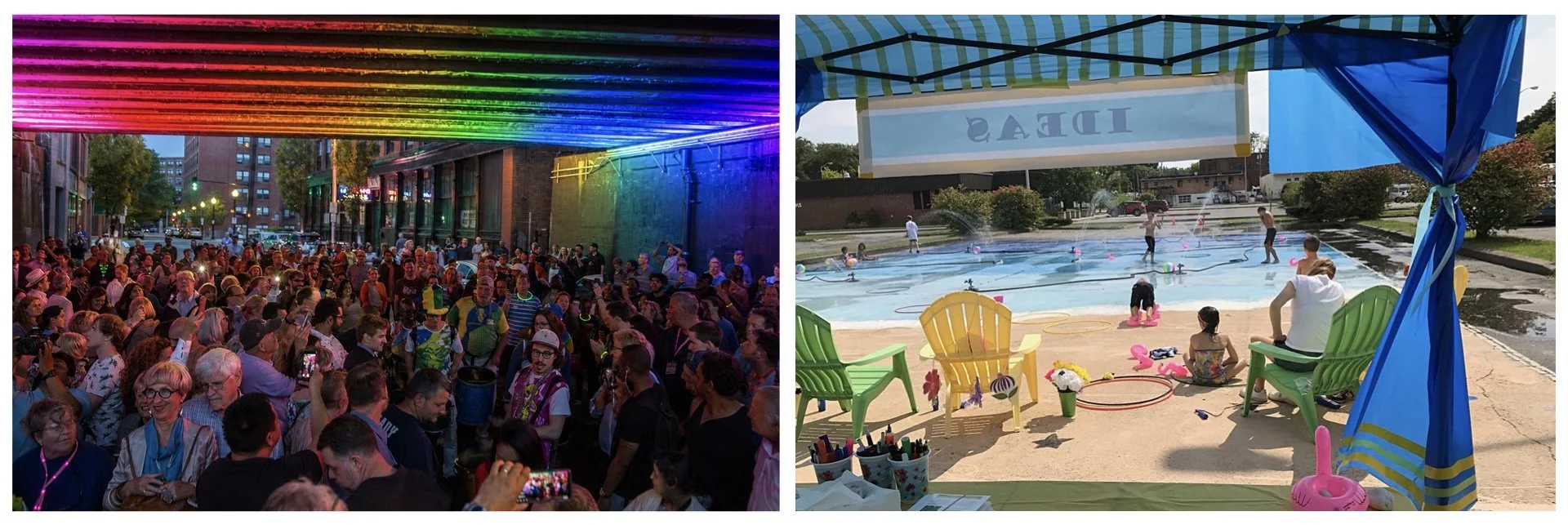
(L) Lynn Lights Installation (Lynn, MA) Image via Beyond Walls | (R) Sprinkler Beach (Monticello, NY) Image via Center for Community Progress
Lynn Lights
In Lynn, Massachusetts, the medium wasn't sculpture, murals, or handcrafted lanterns—it was light. The Lynn Lights initiative, a project of Beyond Walls, transformed a series of uninviting underpasses—long known for dividing neighborhoods and creating an unpleasant, even unsafe, pedestrian experience—into vibrant nighttime canvases through illumination. Each evening, the underpasses come alive, serving as backdrops for festivals, performances, and community gatherings in spaces that once symbolized separation and neglect.
Sprinkler Beach
Perhaps the most playful real-world example is Sprinkler Beach. An underutilized municipal parking lot Monticello, NY was transformed into an "urban beach" complete with sprinklers, seating, games, and community programming. For a few months each year, a place designed almost exclusively for storing cars becomes one of the neighborhood's favorite gathering spots. Nothing about the pavement changed; the reason people came did.
The Common Thread
On paper, these four projects have very little in common. One transformed an abandoned railroad into a celebrated civic destination. Another relied on community programming instead of capital projects. One centered on public art, another on light, and another on water. Some were permanent, others temporary. Some required substantial investment while others relied primarily on creativity and crowdsourcing.
Yet they all accomplished the same thing: they gave people a reason to be there.
That may be the simplest definition of placemaking I've come across.
Which makes me wonder: if those same principles can transform neighborhoods, parks, and downtowns, why should they stop at the front door? Imagine applying that same intentionality to a hotel, a retail store, a university building, or a work.place.
