
Work can happen a lot of places: a operational SOP written in a coffeeshop, a team-building session at a zip-line course, or an important client email written from an iPhone at an airport lounge. Thanks to the rapid advances in technology and communications, our teams are as distributed as ever and teams are finding productivity with more people and in more places than ever before. Employers might not like to hear it, but employees need a reason to come into the office, beyond just work.
This shouldn't be all that surprising as a similar transformation has occurred in another important physical space, Retail. The basis of that transformation; also sweeping advances in technology and a dramatic shift in the landscape of what had previously been accepted as fact. People stayed home, ordered more items online, and we watched our physical retail footprints shrink as millions of square feet of logistics and fulfillment facilities were constructed. Some former retail sites even transformed from places for people into places for things to support the shift.
In order to win back foot traffic and valuable dollars from the consumer, retailers shifted the function of the physical store from purely transactional to deeply experiential. A few great examples stand out and the results speak for themselves:
Rivian Spaces (Meatpacking District, New York City) - A physical place where visitors can see the latest Rivian vehicles alongside adventure gear like bike racks, tents, and mountain bikes. The 'Spaces' also sell one-of-a-kind Rivian merchandise that you can only get in-person. Rivian has yet to start disclosing sales or visitor data for the 'Spaces' but that's really not the point; "We really want to meet our customers where they are, and get people super excited about being able to touch the product” shared Senior Director of Retail Denise Cherry. Rivian uses the 'Spaces' to host community-based events like outdoors interest groups and pet adoptions to further contribute to the draw and sense of community.
Casper Dreamery (New York City) - Online mattress retailer Casper jumped into the brick and mortar business with the opening of a 3,000 square foot experiential storefront in 2018. The space features six "homey" set experiences along with individual napping pods available "testing purposes." They pair the in-store experience alongside popular skincare, lifestyle, and other brands to really sell the lifestyle and vision.
Glossier Retail Store (Seattle, WA) - While the products and packaging may be simple, beauty brand Glossier's retail fronts are anything but. Rather than a stationary place for transactions, the store is filled products to engage with and Instagram-worthy moments to share out. In Seattle, that's a 12 foot mossy mushroom installation smack in the middle of the store. The locations are more than just a building to sling goods, but rather serve as a visual identify for a mostly online retailer and help the brand create meaningful relationships with customers. "As a beauty brand, giving customers the options to trial products in real-time, make their own swatches, and spark beauty discovery, are all reasons why we continue to believe in retail as a key lever for our business" shares Glossier CEO Kyle Leahy.
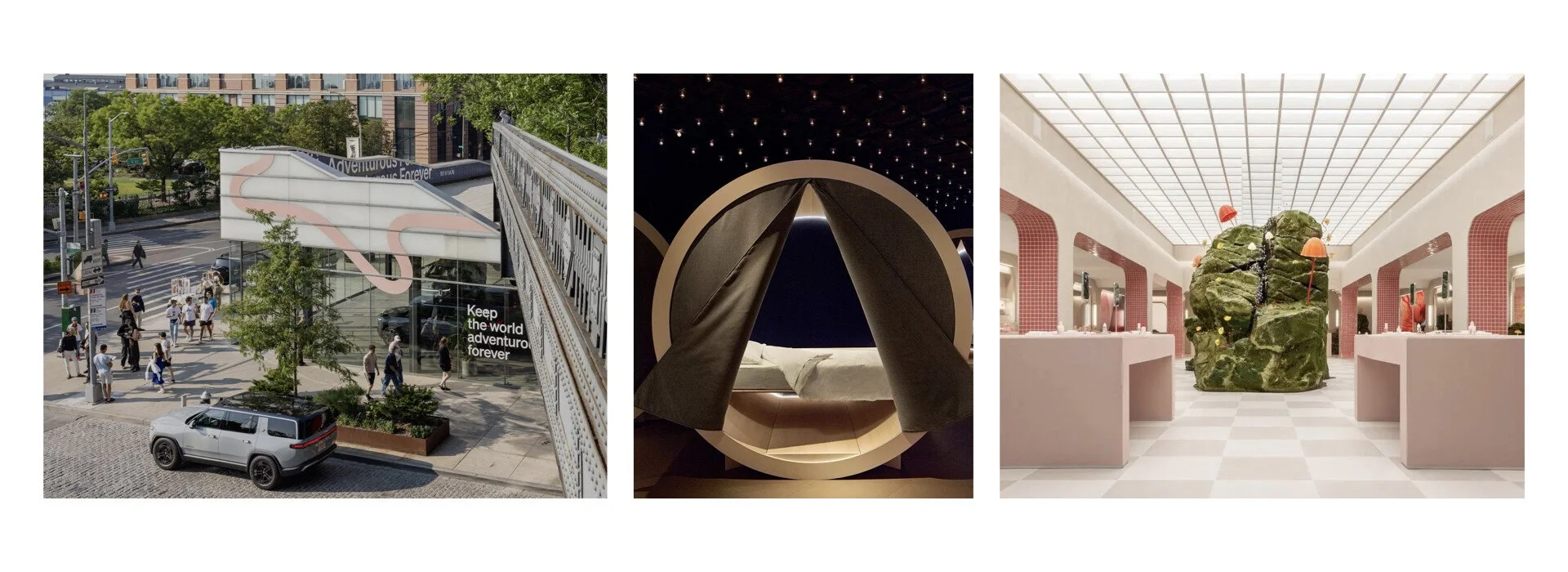
From (L) to (R): Rivian Spaces (Meatpacking District, New York City), The Casper Dreamery (New York City), and a Glossier Retail Store (Seattle, WA) | Images from (L) to (R) by Rivian, Dezeen, and Glossier.
Apple Fifth Avenue (New York City) - Apple is one of the original players in experiential retail investing deeply to turn their retail environments into 'Town Squares.' Rather than stores, the retail spaces host community events, serve as gathering places + destinations, and offer a hands-on environment to test out the latest Apple gadgets in-person. By prioritizing customer experience, investing in their people, and crafting environments that foster hands-on interaction + collaboration, Apple is able to draw record visitor numbers and consistently collect more revenue per square foot ($5,546) than any other retailer.
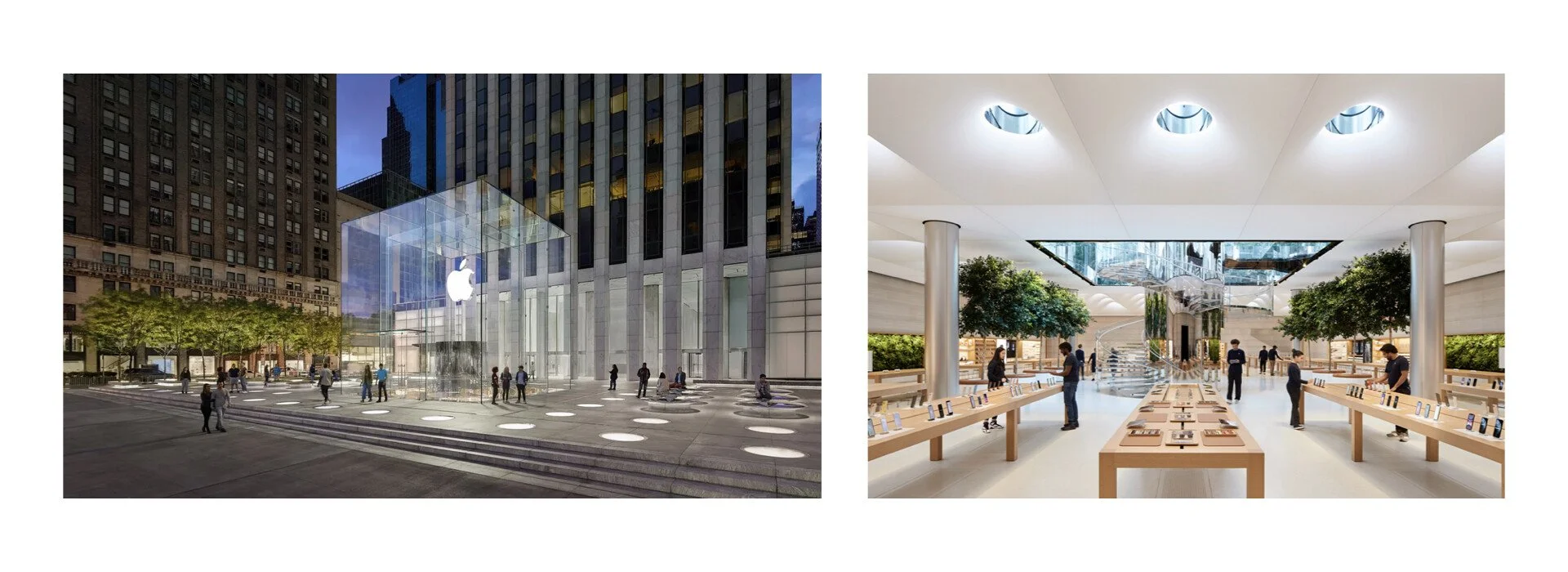
Apple Fifth Avenue (New York City) | Images from Apple
So what shifts can we make in the office to make in-person days more meaningful? How can one craft tomorrow's 'Experiential (Work)place' that employees flock to, not because of a mandate, but because they actually wantto and it helps serve the organization's talent attraction and retention goals. Some ideas:
Purposeful Events + Task Programming
Giving people a reason to get out of their PJ's, brave the commute, and get into the office centers around breaking the monotony of routine and feeding the natural craving for human interaction. Setting meetings for solving those difficult problems on in-person days and scheduling things like team happy hours or lunch-and-learns help give those days more purpose and also help overcome the immense burden that's associated with trekking to a physical workplace environment away from the home. After all, the value of the office is in the people, not the physical place. According to Harvard Business Review, "73% of employees would go to the office more frequently if they knew their direct team members would be there and 84% of employees would be motivated to go into the office if they could socialize with coworkers."
Flexible Working Environments
Different people prefer different physical work environments. For too long the office has been a one-size-fits-all solution of cubicles, task chairs, and fixed workstations. Employers are starting to understand the value of treating work.place as third place; replacing fixed workstations with more flexible seating arrangements, office hoteling, and positioning the office as an active part of the community rather than some distant destination all help to foster creativity + collaboration. Highrise trophy towers are increasingly being replaced with low-slung 'Groundscrapers' that are more human scale, less formal, and with greater connectivity to surroundings and nature. Workplaces that take on the characteristics of your favorite coffeeshop or farmer's market are likely to become the new norm.
Intentional Intermingling
Likewise, the days of different departments occupying set, fixed boundaries are largely over. With different teams adopting different flexible schedules, there's no longer a need for the same amount of fixed workstations occupying valuable real estate. Instead this prized real estate can be traded for more flexible environments and in select cases for other uses entirely such as coworking, with which organizations can flex and grow into. This too allows for greater intermingling and cross-pollination not just amongst teams within an organization but with outside potential vendors, customers, and future customers. With recent Pew data suggesting "46 percent of American workers who are currently working remotely at least some of the time said they’d consider leaving if their employer removed the option to work from home", the arms race for talent attraction and retention is on and a draw to the physical office (not just for the sake of mandate) may just give some organizations that competitive edge.
Instagram-worthy Moments (sort-of)
Ok, so this one isn't an absolute requirement, but brands on the leading edge of future of work are viewing their office environments as more than just physical spaces for holding people. Many offices become a natural extension of the brand identity much in the same way experiential retail gives mostly online brands a sharable, physical presence. Apple occupying a LEED-Platinum HQ on the cutting edge of design & construction nestled within a fruit orchard or a sprawling Nike HQ Campus nestled within the natural surroundings of the Pacific Northwest surrounded by running trails + sports courts - both environments "employees can be proud to call work." The true impact these physical environments make may be up for interpretation, but at the very least it's raising the bar of what's expected of our office environments (goodbye tacky fluorescent lighting, stained carpet, windowless voids, and particle-board cubicles). This is also why increasingly many small companies, independent contractors, and enterprise companies alike are turning to coworking as part of the solution - not just for the physical address but for the boost to their reputation, perceived legitimacy, and professionalism.
So, what does your ideal 'experiential office' environment look like?
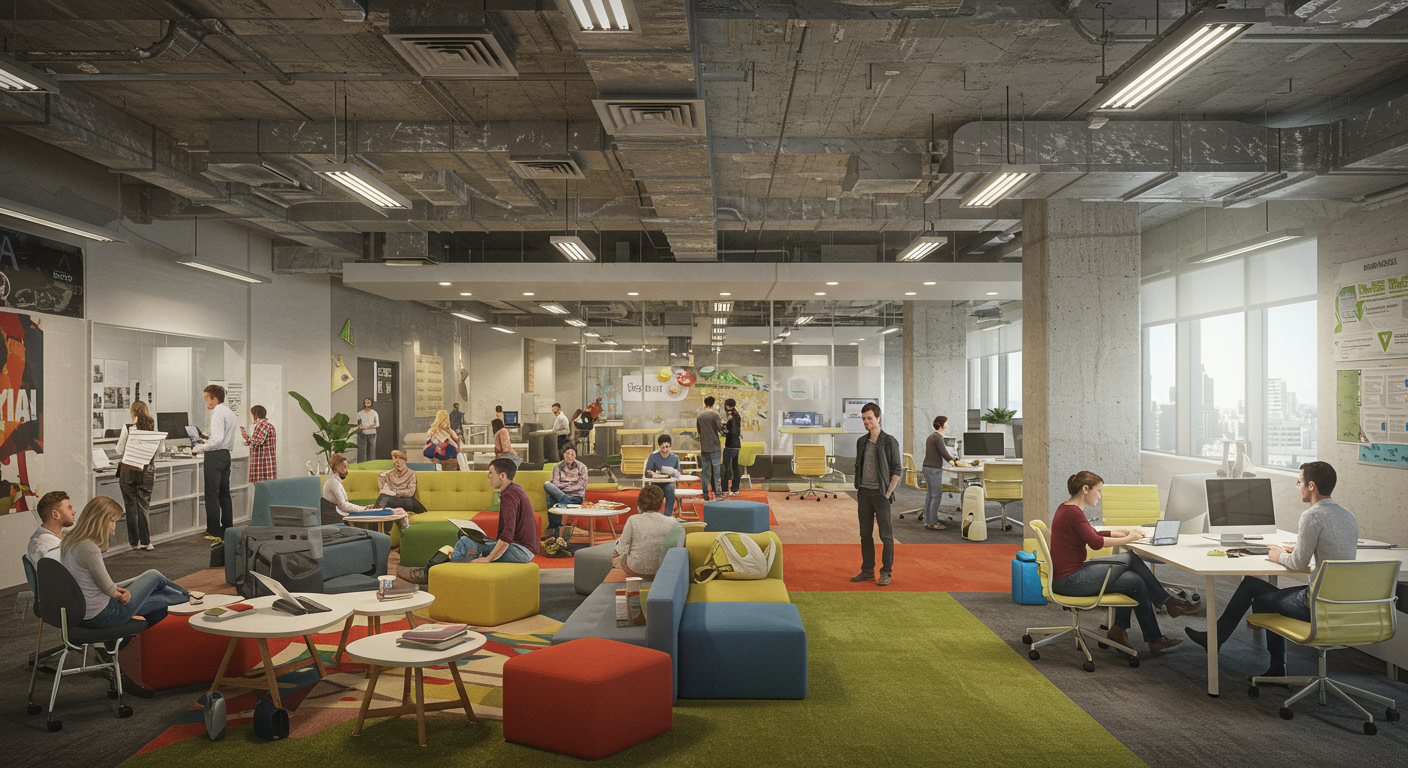
Freepik AI Image Generator Prompt: "Create a dream experiential office that looks more like a theme park or playground" | Image via Freepik AI
