
For decades, companies built offices first and expected the talent to follow. That worked when jobs were tied to zip codes, when being “at HQ” was a prerequisite for corporate influence, and when the technology didn't allow for such seamless remote working. But the world of work has flipped. Today, talent has the leverage, not real estate and the smartest companies are adjusting their work.place strategies accordingly.
Mandate for the sake of Mandate
The best talent doesn’t want to be told where to work. They want the freedom to choose for themselves. Global design firm Gensler noted in 2016 that only 23% of employees had the choice of where to work. That number has since grown to over 73% worldwide. When competing with the home office or even the cozy coffeeshop at the end of the block, people are seeking a destination that’s worthy of the commute.
The office is no longer an obligation, it’s a magnet (a place that pulls people together because it adds value they can’t get anywhere else). When you build around talent instead of forcing talent to build around you, you flip the traditional model on its head. You stop chasing square footage and start cultivating energy density - the buzz that happens when the right people gather with purpose. This isn't some abstract, immeasurable force - work.place strategist + office whisperer Phil Kirschner dives more into the importance of the cultural currency that is social capital in the work.place.
Follow the Talent Map
Look at where your best people already are. Where they live, where they thrive, where they hang out, where they naturally connect. That’s your work.place strategy roadmap. Productivity radiates from people, not buildings. Forward-thinking companies are creating distributed hubs that reflect this new reality:
🏢 A Downtown hub that inspires connection and culture.
🏘️ A Neighborhood work club that supports hybrid flexibility.
🏖️ A Resort or retreat space that fuels deep collaboration and reset.
The office network becomes a constellation of spaces in a variety of different environments for fostering a variety of different activities but all serving the same end purpose. The home office for the Monday morning data aggregation, a co-working space nearby for that Tuesday pick-me-up, the HQ mothership Wednesday for the quarterly in-person reporting; different places and different spaces for different minds and work paces.
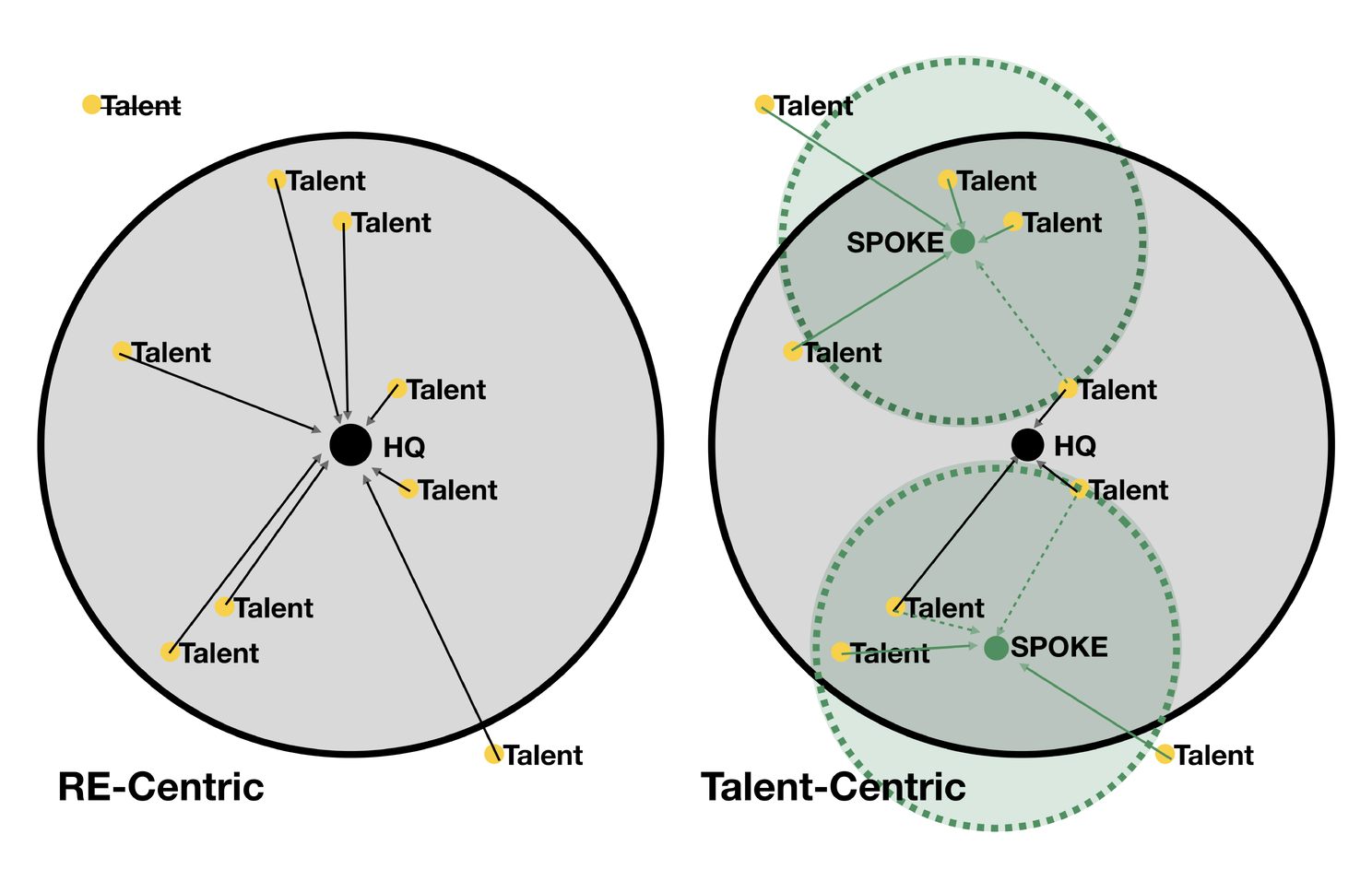
RE-Centric model vs. Talent-Centric model for office location | Diagram by Brendan Gregory
The ROI of Meeting People Where They Are
What does this thinking unlock?
Higher engagement — because people feel seen, not summoned. Choice boosts overall well-being and importantly productivity by as much as 11%.
Better retention — because work fits their life, not the other way around. An extra 20 minutes commuting is equal to a 19% pay cut when measuring job satisfaction.
Smarter real estate — smaller, better-used spaces that actually perform. Occupiers agree with 74% preferring a more distributed model for the productivity, cost, and well-being benefits.
And you attract the next generation of talent who aren’t asking, “Where’s your HQ?.” Instead they’re asking, “How do you support how I actually do my best work?” Because talent doesn’t revolve solely around offices anymore. The companies that win the arms race will be the ones whose offices revolve around their people.
Build where your people are; they’ll build everything else.
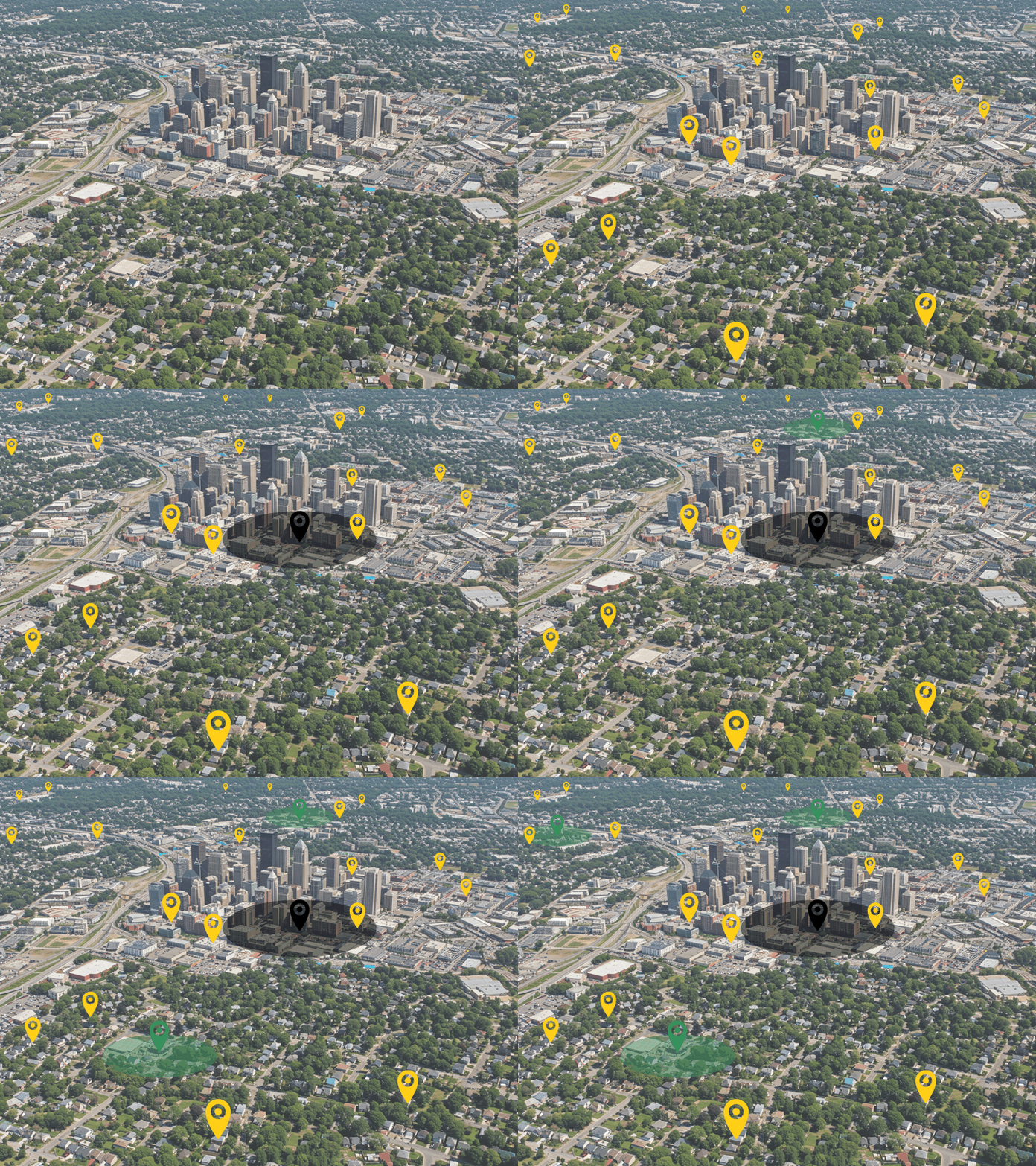
Follow the Talent | Image generated via Freepik AI & Brendan Gregory
